How to support the AIDA project
A computer sitting unused in an office. A few hours of legal advice. A batch of chairs left over after an office move. What has outlived its purpose in one place can get a classroom started in another.
AIDA is building this project from what individuals, companies, foundations, institutions, local authorities, healthcare organisations, schools and universities are willing to share. No contribution is too small — the first technical facility will be assembled one workstation at a time.
Six ways to help
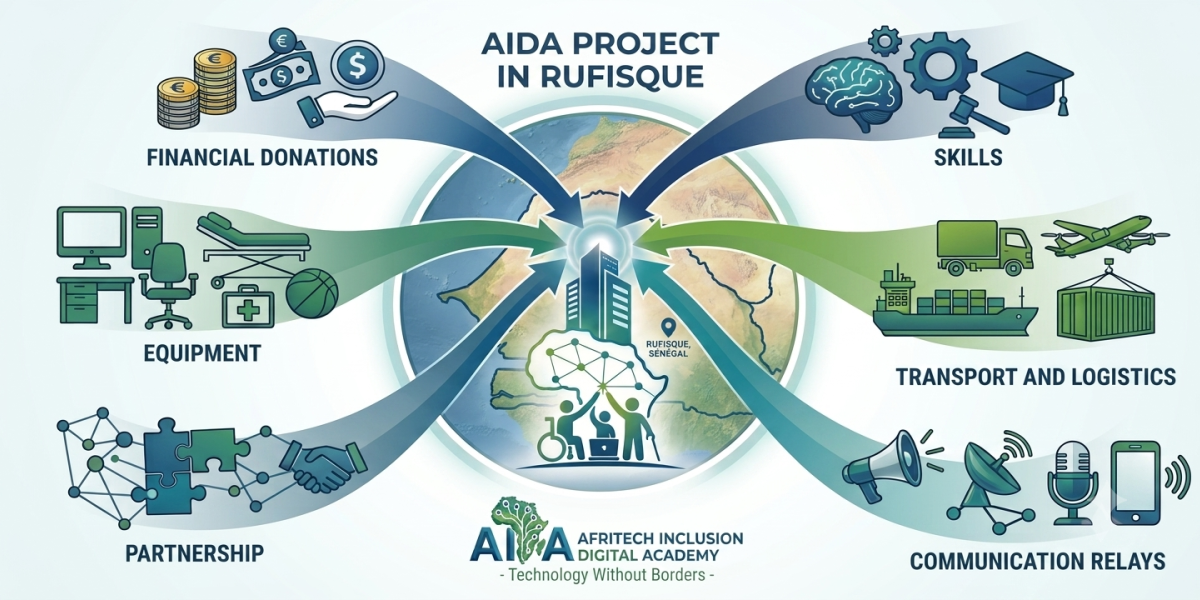
Make a financial donation — towards studies, equipment purchases, transport, fitting out the technical facility and the construction stages that follow.
Donate equipment — IT, networking, furniture, teaching, sports or medical and social care equipment. New, refurbished or second-hand in good condition.
Become a partner — support with staying power: expertise, funding, equipment supply, work placements, employment, certification or mentoring.
Offer a skill — time, know-how or a service: training, architecture, law, communications, healthcare, IT, logistics.
Support transport — getting equipment to Dakar/Rufisque, arranging storage, securing the supply chain. This is often the missing link.
Spread the word — introduce AIDA to companies, institutions, foundations, media, local authorities and professional networks. A well-placed introduction sometimes opens more doors than a donation.
What we need, specifically
IT and networking — computers, monitors, servers, racks, switches, routers, firewalls, Wi-Fi access points, UPS units, projectors, printers, cabling.
Furniture — desks, tables, chairs, cabinets, lockers, shelving, school, office and medical furniture.
Building materials — cement, sand, gravel, steel, blocks, paint, tiling, joinery, plumbing, electrical supplies, roofing, solar panels, batteries.
Accessibility and medical care — equipment adapted for disability, examination tables, wheelchairs, walking frames, rehabilitation equipment.
Sport and adaptive sport — mats, balls, hoops, nets, motor-skills equipment, sports wheelchairs.
School and nursery — books, supplies, educational games, children's furniture, teaching equipment.
Services and skills — architects, engineers, tradespeople, legal advisers, trainers, IT specialists, hauliers, logistics professionals.
What happens after you get in touch
Every offer is assessed against what the project actually needs at the time. For equipment, we check that it works and assess its compatibility, safety and educational value before accepting it — better to decline something unusable than have it shipped for nothing.
We reply to every message within a few working days, including when an offer doesn't match our current needs.
Write to us — even if you're still unsure what you could offer.